

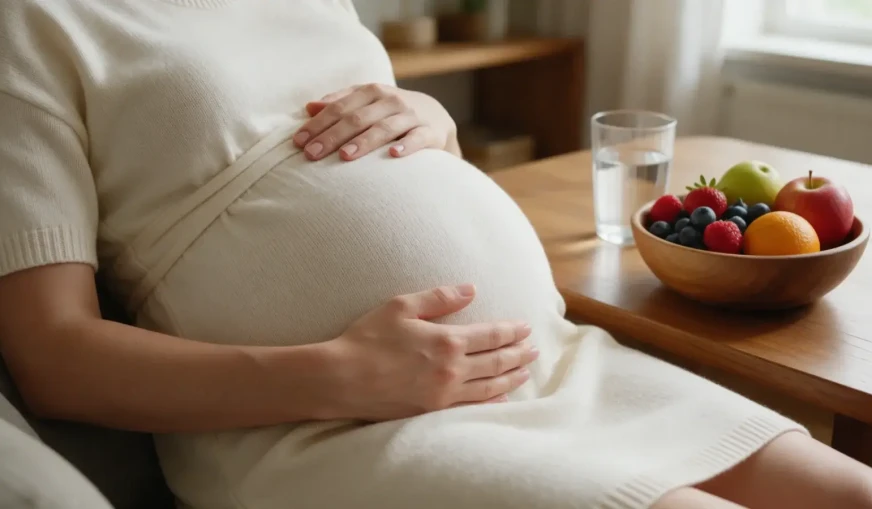
The weight you are advised to gain in pregnancy depends on your weight before pregnancy. For an expectant mother who starts pregnancy at a normal weight (BMI 18.5–24.9), the recommended total gain is about 11.5–16 kg; the range is higher for those who start underweight and lower for those who start overweight. Most of the weight is gained after week 20.
The number on the scales does not tell you much on its own; what matters is the pace of the gain and how it fits with your baby's development. Below you will find tables to locate your own range, the expected progress week by week and practical ways to keep weight gain in balance. Your monitoring should always follow your obstetrician's advice.
- The recommended total gain is set according to your pre-pregnancy body mass index (BMI).
- About 11.5–16 kg is recommended for those who start at a normal weight; more for those who start underweight and less for those who start overweight.
- In the first three months the gain is usually limited to 0.5–2 kg; the main gain happens in the second and third trimesters.
- Pregnancy is not the time to diet; the aim is not to lose weight but to eat in a balanced and adequate way.
- If you have a sudden weight gain over a few days along with marked swelling of the face, hands or feet, see a doctor straight away.
Why Does Weight Gain in Pregnancy Differ From Woman to Woman?
Because everyone starts from a different point. The body of a mother who starts pregnancy underweight needs more stores, whereas for a mother who starts overweight a more limited gain is safer for both mother and baby.
The NHS (the UK National Health Service) notes that most women gain between 10 and 12.5 kg during pregnancy and that most of this comes after week 20. However, this is an average; a twin pregnancy, your pre-pregnancy weight, the severity of nausea and your daily activity level all change the result. If you do not know your starting value, you can first look at the article on how to calculate body mass index; use your pre-pregnancy weight for the calculation.
How Much Weight Should You Gain According to Pre-Pregnancy BMI?
The most widely used framework is the 2009 recommendations of the US Institute of Medicine (IOM), which the American College of Obstetricians and Gynecologists (ACOG) also bases its advice on. The values in the table are for singleton pregnancies.
| Pre-pregnancy BMI | Recommended total weight gain | Weekly average in the 2nd and 3rd trimesters |
|---|---|---|
| Below 18.5 (underweight) | 12.5–18 kg | about 0.5 kg |
| 18.5–24.9 (normal) | 11.5–16 kg | about 0.4 kg |
| 25–29.9 (overweight) | 7–11.5 kg | about 0.3 kg |
| 30 and above (obese) | 5–9 kg | about 0.2 kg |
In twin pregnancies the recommended ranges are higher and must be set together with your doctor. For expectant mothers with a BMI above 30 or below 18.5, the NHS also advises getting specific advice from a midwife or doctor.
How Does Weight Gain Progress Week by Week?
Weight gain in the first three months is usually small; it is also common to gain no weight at all, or even to lose a little, because of nausea. The gain speeds up with the second trimester and continues fairly steadily until birth.
The table below is an approximate roadmap calculated from the recommended weekly rates for an expectant mother who starts pregnancy at a normal weight. Being slightly below or above this range in a given week of measurement does not by itself mean a problem; your doctor looks at the trend and your baby's growth.
| Week of pregnancy | Total gain (approximate) | Note |
|---|---|---|
| Weeks 1–13 | 0.5–2 kg | Gain may be lower if you have nausea |
| Week 20 | 3–5.5 kg | Weekly gain starts to speed up |
| Week 28 | 6–9.5 kg | Start of the third trimester |
| Week 36 | 8.5–13.5 kg | Fluid retention can shift the scales within a few days |
| Week 40 | 10–16 kg | Approaching the recommended total range |
Weighing yourself once a week rather than every day, on the same day, in the morning on an empty stomach and in similar clothing, gives more meaningful monitoring.
Where Does the Weight Gained Go?
Only part of the weight gained in pregnancy is the baby itself; the rest is the tissues that sustain the pregnancy, the increased blood and fluid volume, and fat stored in preparation for breastfeeding. That is why a certain amount of weight gain is not only normal but necessary.
- Baby: on average 3–3.5 kg at birth
- Placenta and amniotic fluid: about 1.5 kg
- Growing uterus and breast tissue: about 1.5 kg
- Increased blood volume and body fluid: about 3 kg
- Fat stores: about 3–4 kg (an energy reserve for the breastfeeding period)
These figures are general estimates that vary from person to person. The NHS also stresses that a significant part of the extra weight is fat stored for making breast milk after birth. If you are curious about the postpartum period, the page on nutrition while breastfeeding is a good place to start.
Do You Need to “Eat for Two”?
No. In the first three months most expectant mothers do not need extra energy; the need rises in the second and especially the third trimester, by a few hundred calories a day. That is as small a difference as adding one snack.
What increases in pregnancy is not quantity but quality: nutrients such as folate, iron, iodine, calcium, good-quality protein and omega-3. Giving half the plate to vegetables and fruit, a quarter to wholegrains and a quarter to meat, chicken, fish, eggs or pulses, and adding two or three portions of dairy a day, offers a framework that is enough for most days. For the needs that change by trimester, you can also look at the article on the month-by-month nutrition chart for pregnancy. If you are looking for a sample day for early pregnancy, see the menu in the article on nutrition in the first 3 months of pregnancy.
What Are the Risks of Gaining Too Much or Too Little?
Gaining markedly more than recommended can raise the risk of gestational diabetes and high blood pressure; falling markedly below the recommendation is linked to preterm birth and low birth weight (under 2.5 kg). In both cases the goal is not to restrict eating but to organise it. You can find what really affects a baby's growth in the article on foods that help a baby gain weight, and advice on reducing the risk of gestational diabetes in the gestational diabetes nutrition guide.
The point the NHS particularly underlines is this: pregnancy is not the time to diet. For an expectant mother who starts overweight too, the aim is not to lose weight but to keep the gain within the recommended range. Skipping meals, cutting out carbohydrates completely or following very low-calorie lists also restricts the nutrients your baby needs.
What Can You Do to Keep Weight Gain in a Healthy Range?
The most effective methods are simple and sustainable ones: regular mealtimes, controlling portions through the layout of your plate, and daily movement to the extent your doctor approves.
- Plan three main meals and one or two snacks as needed; long gaps without food lead to overeating at the next meal.
- For snacks, choose yoghurt and fruit, a handful of nuts or vegetable sticks instead of biscuits, crisps and sugary drinks.
- Eat the fruit itself rather than fruit juice; satisfy a sweet craving with small portions.
- Choose cooking methods such as baking, boiling and grilling instead of frying.
- If there is no reason not to, keep up your daily walks; talk to your doctor about an exercise plan.
- Do not neglect safe food choices: a single look at the list of what not to eat during pregnancy makes things easier.
Complaints such as heartburn or nausea can also affect weight gain; the suggestions in the article on nausea during pregnancy may help during those periods.
When Should You See a Doctor About Weight Gain?
If a marked weight gain over a few days comes with sudden swelling in the face, hands and feet, a severe headache or visual disturbances, see your doctor or go to the maternity unit without delay. This picture can be a sign of a condition that needs monitoring, such as pre-eclampsia.
If you cannot gain any weight for a long time, cannot eat because of vomiting, or your weight gain is well above the recommended range, talk about it without waiting for your next check-up. For a weight goal and nutrition plan that suit you in pregnancy, we can work together, in line with your obstetrician's advice, within nutrition counselling for pregnancy. If you are planning a pregnancy, balancing your starting weight during pregnancy preparation also makes things easier.
Sources
- NHS – Weight gain in pregnancy
- ACOG – Weight Gain During Pregnancy (Committee Opinion)
- NHS – Have a healthy diet in pregnancy
- WHO – Recommendations on antenatal care for a positive pregnancy experience
This article is for general information only; please consult your doctor and dietitian about your own situation.
Frequently Asked Questions
Is it normal to lose weight in the first 3 months of pregnancy?
Expectant mothers with severe nausea and vomiting may lose some weight in the first weeks. If you cannot keep fluids down, are vomiting all day or are losing weight quickly, tell your doctor without waiting; a slight dip usually evens out as the nausea eases.
How much weight is normal to gain per week in pregnancy?
For an expectant mother who starts at a normal weight, an average of about 0.4 kg a week is recommended in the second and third trimesters. This figure is slightly higher for those who start underweight and lower for those who start overweight. The trend over a few weeks matters more than single-week fluctuations.
I started pregnancy overweight; can I diet during pregnancy?
Weight-loss diets are not recommended in pregnancy. The aim is to keep weight gain within the recommended range and to raise the quality of what you eat. The safest way is to make this plan together with your obstetrician and dietitian.
How much weight should you gain with twins?
In twin pregnancies the recommended total weight gain is higher than for a singleton pregnancy and varies with your pre-pregnancy BMI. Always set the target range and nutrition plan together with your doctor.
How long does it take to lose the weight after birth?
The weight of the baby, placenta and fluid comes off in the days and weeks after birth; the fat stores take longer to go down and vary from person to person. Breastfeeding and balanced eating support this process; stay away from quick weight-loss lists.
Book an appointment for a personalised pregnancy nutrition plan
Nutritional needs in pregnancy change with the week of pregnancy, weight change and test results. Message us for a plan that fits your doctor's advice.

This content is for information only. For a personalised nutrition programme, please consult a dietitian.


