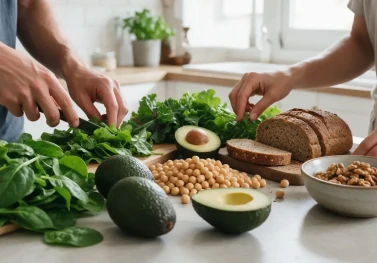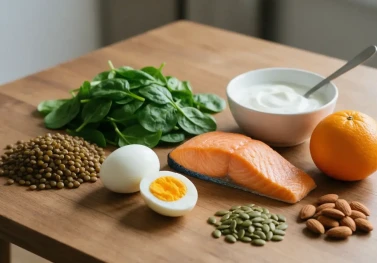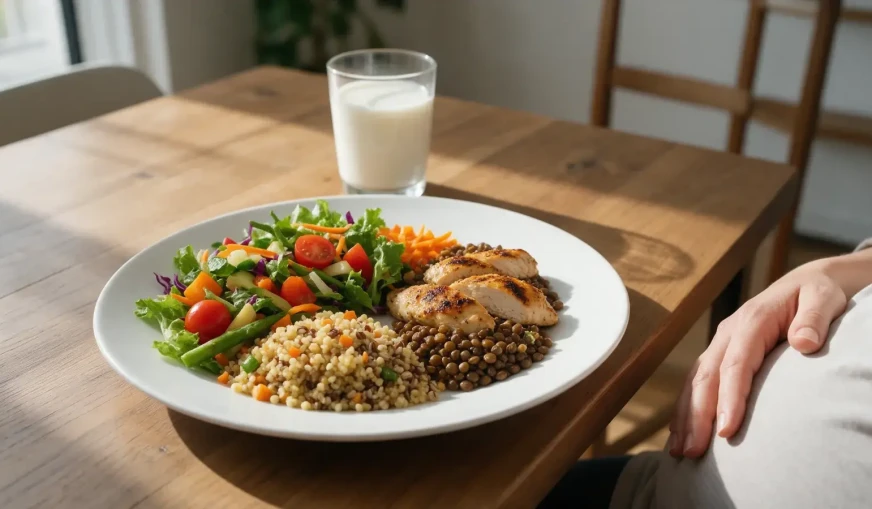
In pregnancy, half of a healthy plate is made up of vegetables and fruit, a quarter of wholegrains, and a quarter of protein sources such as well-cooked meat, chicken, fish, eggs or pulses, with a portion of dairy and a small amount of healthy fat alongside. You do not need a special diet; what matters is eating a variety of safe foods every day.
When you get the news that you are pregnant, one of the most common questions is “What should I eat now?” In this article I focus less on what is off limits and more on what should be on your plate every day: a practical plate model, examples by food group and the safety points to watch.
- Half the plate vegetables and fruit, a quarter wholegrains, a quarter protein, with dairy and a little healthy fat on the side.
- You do not need to “eat for two” in pregnancy; what increases is the need for food quality rather than quantity.
- Two portions of low-mercury fish a week, 2–3 portions of dairy a day and plenty of vegetables are recommended.
- Meat, chicken and eggs should be cooked thoroughly; avoid unpasteurised dairy products and high-mercury fish.
- Supplements and your personal portions should be set in line with your obstetrician's advice.
How Do You Build a Healthy Pregnancy Plate?
A healthy pregnancy plate is a balanced one that includes every food group at each meal: half vegetables and fruit, a quarter wholegrains and starchy foods, and a quarter protein. You do not have to hit this ratio exactly at every meal; getting the balance across the week is enough.
The NHS also recommends that, rather than a special diet in pregnancy, you eat a variety of foods from different food groups every day and achieve that balance over a week. In practice, this means familiar combinations such as a vegetable dish, bulgur pilaf and yoghurt at lunch, and grilled fish, salad and wholemeal bread in the evening.
| Food group | Daily target (approximate) | Examples |
|---|---|---|
| Vegetables and fruit | At least 5 portions, mostly vegetables | Spinach, broccoli, carrots, courgettes, tomatoes, oranges, apples |
| Wholegrains and starchy foods | Some at every meal | Bulgur, oats, wholemeal bread, brown rice, potatoes |
| Protein sources | Every day, at every main meal | Well-cooked meat and chicken, eggs, lentils, chickpeas, beans; 2 portions of fish a week |
| Milk and dairy products | 2–3 portions | Pasteurised milk, yoghurt, ayran (Turkish salted yoghurt drink), kefir, pasteurised cheese |
| Healthy fats | A small amount | Olive oil, walnuts, hazelnuts, almonds |
This table is a general framework; portion sizes vary with your pre-pregnancy weight, how far along you are, your activity level and your health.
Why Do Different Food Groups Matter in Pregnancy?
Each food group has a different job in pregnancy: vegetables and fruit provide vitamins, minerals and fibre; grains provide energy; protein sources support the building of the baby's tissues; and dairy provides calcium. Leaving out a group completely can lead to gaps in certain nutrients.
Vegetables and fruit
Dark green leafy vegetables provide folate, citrus fruit provides vitamin C, and orange and yellow vegetables provide beta-carotene, a precursor of vitamin A. Thanks to their fibre they also help with constipation, which is common in pregnancy. Remember to wash vegetables and fruit that will be eaten raw thoroughly under plenty of running water.
Wholegrains
High-fibre choices such as bulgur, oats and wholemeal bread, rather than white bread and rice, raise blood sugar more steadily and keep you full for longer. Grains are the main energy source in pregnancy, so they should not be cut out completely.
Protein sources
Meat, chicken, fish, eggs and pulses provide iron and zinc as well as the protein the baby needs to grow. Two portions of fish a week are recommended, one of them an oily fish such as salmon or sardines; high-mercury species such as shark and swordfish should be avoided.
Dairy products
Milk, yoghurt, ayran and cheese are sources of calcium and protein. In pregnancy, choose only pasteurised dairy products and keep away from unpasteurised ones such as village cheese.
Do You Really Need to Eat More in Pregnancy?
Energy needs rise in pregnancy, but the increase is not as large as people think and becomes noticeable mainly in the last months. So instead of “eating for two”, the aim is to get more vitamins, minerals and protein from the same amount of energy.
Excess weight gain can raise the risk of conditions such as gestational diabetes and high blood pressure, while undereating can also affect the baby's growth. Your obstetrician monitors the weight gain that is right for you in pregnancy, based on your pre-pregnancy weight. For a sample day specific to early pregnancy, take a look at my article on nutrition in the first 3 months of pregnancy.
What Does a Sample Day in Pregnancy Look Like?
A sample day consists of a breakfast that includes protein, two main meals and two or three small snacks as needed. Small, frequent meals also help in managing pregnancy complaints such as nausea and heartburn.
- Breakfast: Thoroughly cooked egg, pasteurised white cheese, olives, tomato, cucumber, greens and wholemeal bread.
- Snack: A bowl of yoghurt and a seasonal fruit.
- Lunch: A vegetable dish with meat or pulses, bulgur pilaf, cacik (Turkish yoghurt and cucumber dip).
- Snack: A handful of walnuts or almonds and a glass of milk.
- Dinner: Baked salmon, boiled potatoes or brown rice, a seasonal salad.
If you cannot tolerate some foods because of nausea, you can use the suggestions in my article on nausea during pregnancy.
A practical shopping list for the pregnancy plate
The easiest way to build a balanced plate every day is to have the right ingredients ready in the kitchen. Keeping these basics in your weekly shop lets you put together practical, nourishing meals even on days when you are tired:
- Seasonal vegetables, leafy greens and frozen vegetables (spinach, peas, broccoli)
- Seasonal fruit and, in small amounts, dried fruit such as dried apricots and figs
- Bulgur, oats, wholemeal bread, brown rice
- Red lentils, chickpeas, dried beans
- Eggs, chicken, red meat and fish you can cook twice a week
- Pasteurised milk, yoghurt, ayran, kefir and pasteurised cheese
- Olive oil, raw walnuts, hazelnuts and almonds
Setting aside one day a week to boil a few batches of pulses and prepare a vegetable dish and bulgur pilaf to keep in the fridge largely solves the daily “what shall I eat?” question.
What Should You Drink in Pregnancy?
The main drink in pregnancy is water; ayran, milk and kefir are also good options. Caffeinated drinks should be limited, and alcohol should not be consumed at all during pregnancy.
Sweetened fruit juices, fizzy drinks and ready-made iced teas add extra energy and sugar. Take care to keep the total caffeine in coffee, tea, cola and energy drinks below the limit your doctor recommends. Do not assume herbal teas are harmless just because they are “natural” either; ask your doctor which herbal teas are suitable.
What Should You Watch for on a Pregnancy Plate?
The most important safety rule on a pregnancy plate is that animal foods are thoroughly cooked and dairy products are pasteurised. Raw and undercooked meat, foods made with raw egg, unpasteurised dairy products, raw seafood and high-mercury fish are not recommended because of risks such as listeria, salmonella and toxoplasma.
Liver and liver products are not recommended in pregnancy because of their high vitamin A content. You can find a detailed list of foods to avoid in my article on what not to eat during pregnancy. Use supplements such as folic acid, iron or vitamin D on your doctor's advice, not on your own; I explain how you can get support from food in the article on vitamin and mineral needs during pregnancy.
When Should You Seek Support?
See your doctor straight away if you have severe and persistent vomiting, cannot keep any fluids down, lose weight suddenly or gain weight rapidly, have sudden swelling, a severe headache or visual disturbances. These symptoms should be handled through medical assessment, not through diet.
In situations such as gestational diabetes, anaemia, thyroid disease, a multiple pregnancy or a vegetarian diet, your plate needs to be planned individually. In line with your obstetrician's advice, we can work together on a suitable plan within nutrition counselling for pregnancy.
Sources
- NHS – Have a healthy diet in pregnancy
- NHS – Foods to avoid in pregnancy
- WHO – Recommendations on antenatal care for a positive pregnancy experience
- Turkish Ministry of Health – Turkey Nutrition Guide (TÜBER) 2022
This article is for general information only; please consult your doctor and dietitian about your own situation.
Book an appointment for a personalised pregnancy nutrition plan
Nutritional needs in pregnancy change with the week of pregnancy, weight change and test results. Message us for a plan that fits your doctor's advice.

This content is for information only. For a personalised nutrition programme, please consult a dietitian.