

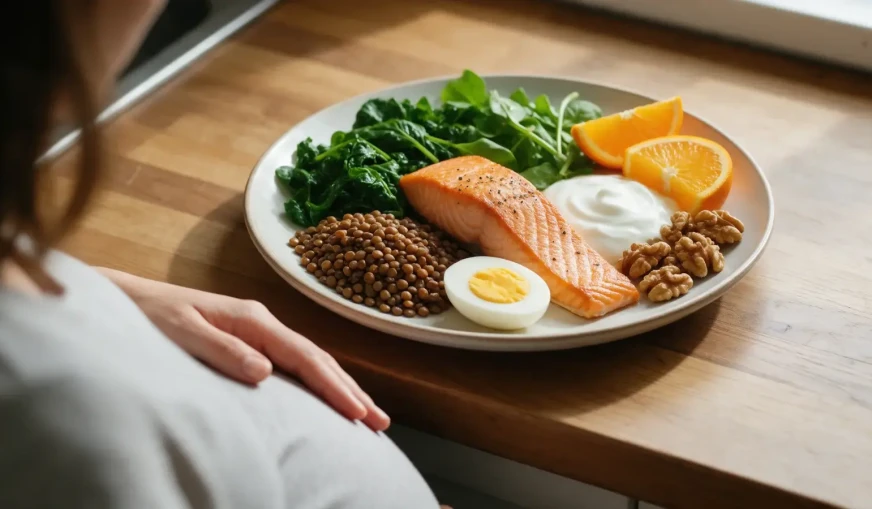
Most of the vitamin and mineral needs in pregnancy can be met with a varied and balanced diet; however, for a few nutrients such as folic acid, vitamin D and, in some cases, iron, relying on your plate alone is not enough. Your obstetrician decides which supplement you need and when; you can plan with your dietitian how to get the most from food.
While energy needs rise very little in the first months of pregnancy, the needs for some micronutrients rise noticeably. In other words, what matters is not "eating for two" but "quality for two". Below you will find the vitamins and minerals people ask about most, their good food sources and points to watch.
- In pregnancy, folate, iron, iodine, calcium, vitamin D, B12, choline and omega-3 fatty acids stand out.
- Leafy green vegetables, pulses, eggs, dairy products, well-cooked meat and suitable fish form the basis of meeting these needs.
- Folic acid and vitamin D supplements come up in most pregnancies; the dose and duration are decided by your doctor.
- Liver and supplements containing vitamin A (retinol) are not recommended in pregnancy.
- Do not start any supplement, including herbal and "natural" products, without talking to your doctor.
Which Vitamin and Mineral Needs Rise in Pregnancy?
The nutrients that need the most attention in pregnancy are folate, iron, iodine, calcium, vitamin D, vitamin B12, choline and omega-3 fatty acids such as DHA. These are needed for the baby's nervous system, bones and blood, and for protecting the mother's own stores.
The period in which each nutrient matters most is slightly different. Folate is most critical in the first weeks of pregnancy, when the neural tube closes; the need for iron rises noticeably in the second and third trimesters, when blood volume increases. So the eating plan should be updated as pregnancy progresses.
In my work, something I often see is that when a supplement is used, the plate gets neglected. Yet supplements complete eating; they do not replace it. Fibre, protein, healthy fats and hundreds of protective compounds only come from real food.
Which Nutrient Is Found in Which Foods?
As a practical rule, having a source of protein, a vegetable or fruit, and a wholegrain or pulse at every meal helps you meet most of the nutrients below without trying. The table gives a general framework; the amounts that suit you should be set according to your personal situation.
| Nutrient | Role in pregnancy | Good food sources | Points to note |
|---|---|---|---|
| Folate | Development of the neural tube, cell division | Spinach, broccoli, lentils, chickpeas, dried beans, oranges | A folic acid supplement usually starts before pregnancy; on your doctor's advice |
| Iron | Increased blood volume, carrying oxygen to the baby | Well-cooked red meat, chicken, pulses, eggs, dark green leafy vegetables | Eat plant-based iron with vitamin C |
| Iodine | The baby's brain development, thyroid function | Iodised salt (in small amounts), milk and dairy products, eggs, fish | Choose iodised salt rather than increasing the amount of salt |
| Calcium | The baby's bone and tooth development | Milk, yoghurt, cheese, kefir, sesame, leafy greens | Drinking tea and coffee away from meals helps absorption |
| Vitamin D | Calcium absorption, bone health | Sunlight, egg yolk, oily fish | Food may not be enough; your doctor decides on a supplement |
| Vitamin B12 | Blood production, nervous system | Meat, fish, eggs, dairy products | Vegetarians and vegans are more likely to need a supplement |
| Choline | Development of the brain and nervous system | Eggs, meat, fish, pulses | Eat eggs fully cooked |
| Omega-3 (DHA) | Brain and eye development | Low-mercury fish such as salmon, sardines and anchovies; walnuts | Avoid large fish that are high in mercury |
Is a Folic Acid Supplement Needed, or Is Food Enough?
Folate is found naturally in food, but it is hard to meet the high need of the first weeks of pregnancy safely from food alone. That is why many health authorities, including the UK National Health Service (NHS), recommend a folic acid supplement for women who are planning a pregnancy and in the first months of pregnancy; your doctor decides the dose and duration according to your history.
When you use a supplement, you still need to keep eating a diet rich in folate. Lentil soup, a chickpea salad, eggs with spinach and an orange are practical options that easily raise folate intake through the day. I have described in detail what can be done before pregnancy on my page on preconception nutrition.
How Are Iron and Calcium Met in Pregnancy?
A good start for iron is to combine animal sources (well-cooked meat, chicken, eggs) with plant sources (lentils, chickpeas, dried beans, dark green leafy vegetables), and for calcium to have two or three portions of milk, yoghurt or cheese every day.
Plant-based iron is absorbed less well. Adding a salad with lemon to a lentil dish, or a mandarin for dessert, increases absorption thanks to the vitamin C. Tea and coffee can reduce iron absorption, so they should be drunk not with the meal but at least an hour after it.
Calcium and iron can compete for absorption. So if your doctor has recommended an iron supplement, you may be asked not to take it at the same time as milk and yoghurt. If you have symptoms of anaemia, the article on foods for anaemia may also be a guide.
What Should You Look Out for with Vitamin D, Iodine and Omega-3?
Because vitamin D is found only in limited amounts in food and sun exposure varies widely from person to person, supplements are often planned in pregnancy by looking at blood levels. For iodine, iodised salt and dairy products are the main sources, and for omega-3, low-mercury fish twice a week.
- Vitamin D: Egg yolk and oily fish contribute; however, if your level is low, your doctor makes the decision about a supplement.
- Iodine: Use iodised salt at home, but do not increase the total amount of salt. The salt in ready-made foods is usually not iodised.
- Omega-3: Eat small and medium-sized fish such as salmon, sardines, anchovies and horse mackerel, well cooked. Large predatory fish such as shark and swordfish are not recommended because of their high mercury.
Which Vitamins Are Harmful in Excess in Pregnancy?
"More is better" is not the right approach in pregnancy. In particular, because the retinol form of vitamin A can harm the baby when taken in large amounts, liver, liver pâté and supplements containing retinol are not recommended in pregnancy.
Multivitamins made specially for pregnancy are produced with this risk in mind; however, using more than one product together can push some vitamins over the upper limit. Among fish oil products, those containing fish liver oil can also be rich in vitamin A. Show every product you use, including herbal ones, to your doctor at your check-ups. For a wider list of foods to avoid in pregnancy, you can look at the article on foods to avoid in pregnancy.
What Should Vegetarians and Vegans Watch For?
In pregnant women who eat mostly plant foods, B12, iron, iodine, calcium, omega-3 and protein need to be planned more carefully. Because B12 is not found in reliable amounts in plant foods, vegans almost always need a supplement.
Combining pulses with grains, adding nuts and seeds to snacks and choosing plant milks fortified with calcium help to close the gap. You can read my article on vegetarian eating in pregnancy for a detailed framework.
How Can These Needs Be Met in One Day?
The sample day below does not show a single right menu, but how nutrients can be spread across meals. Amounts vary according to your week of pregnancy, your weight gain and any conditions such as gestational diabetes.
- Breakfast: A hard-boiled egg, white cheese, tomato, cucumber, plenty of greens and wholegrain bread.
- Snack: A bowl of yoghurt and a handful of walnuts.
- Lunch: Lentil soup, a rocket salad with lemon and bulgur pilaf.
- Snack: An orange or mandarin and a few dried apricots.
- Dinner: Well-baked salmon or meatballs (köfte), broccoli cooked in olive oil and cacık (yoghurt with cucumber).
In the first weeks, when you have nausea, this pattern may not always be possible; in that period small, frequent meals are enough. Suggestions adapted for the first trimester are in the article on eating in the first 3 months of pregnancy.
If you would like a personal plan for every stage of your pregnancy, in line with your obstetrician's advice, we can work together through nutrition counselling in pregnancy. If you have severe vomiting, bleeding, sudden swelling, or a headache with visual disturbance, see your doctor straight away without waiting for eating advice.
Sources
- NHS – Have a healthy diet in pregnancy
- NHS – Foods to avoid in pregnancy
- WHO – Recommendations on antenatal care for a positive pregnancy experience
- Turkish Ministry of Health – Turkey Nutrition Guide (TÜBER) 2022
This article is for general information only; please consult your doctor and dietitian about your own situation.
Frequently Asked Questions
Is it essential to take a multivitamin in pregnancy?
The answer is not the same for every pregnant woman. Folic acid and vitamin D come up in most pregnancies; other supplements, such as iron, B12 or iodine, are planned according to your blood values, the way you eat and your health history. Your obstetrician should decide which product you use.
If I take supplements, do I still need to watch my diet?
Yes. Supplements top up certain vitamins and minerals, but they do not provide the protein, fibre, healthy fats and protective compounds in vegetables and fruit. A balanced plate is also a precondition for really benefiting from a supplement.
What can be done if iron supplements cause constipation in pregnancy?
Eating more high-fibre foods (vegetables, fruit, wholegrains, pulses), drinking enough water spread through the day and moving to the extent your doctor approves often brings relief. If your complaint continues, talk to your doctor about a different option rather than stopping the supplement yourself.
Do herbal teas and natural supplements meet vitamin needs?
No. Herbal teas are not a suitable way to meet vitamin and mineral needs, and some herbs are not recommended in pregnancy. Talk to your doctor before using any supplement, including products labelled "natural".
Do tea and coffee affect vitamin absorption?
Some compounds in tea and coffee can reduce the absorption of plant-based iron in particular. It is recommended to drink these drinks about an hour after a meal rather than with it, and to limit the total amount of caffeine in pregnancy.
Book an appointment for a personalised pregnancy nutrition plan
Nutritional needs in pregnancy change with the week of pregnancy, weight change and test results. Message us for a plan that fits your doctor's advice.

This content is for information only. For a personalised nutrition programme, please consult a dietitian.


