

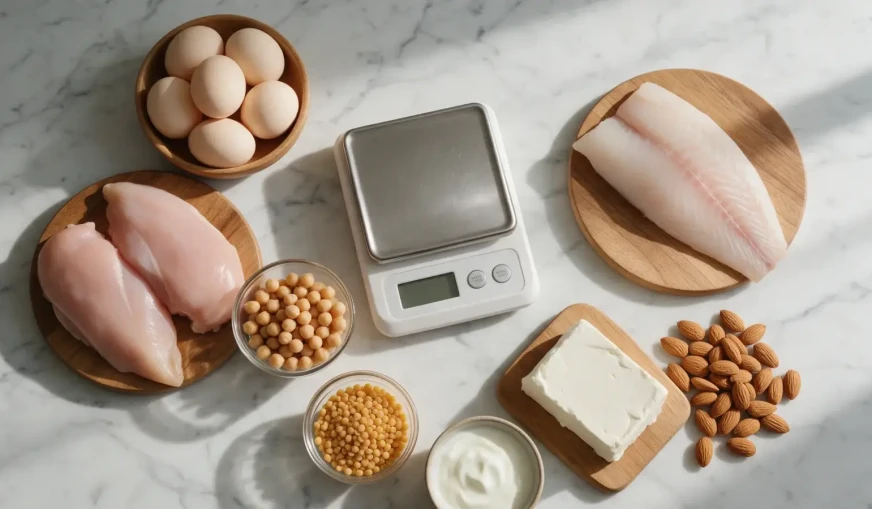
In its simplest form, daily protein need is calculated per kilogram of body weight. The Turkish Nutrition Guide (TÜBER) recommends 0.83–1.0 grams of protein per kilogram a day for healthy adults; for a 70 kg adult that is about 58–70 grams. The need rises in athletes, older people, pregnancy and breastfeeding, and during active weight loss; in conditions such as kidney disease, the target must always be set with a doctor.
Protein is the building block of muscles, immune cells, enzymes and hormones. But it is not a nutrient of which “the more the better”. Below you will find, step by step, how to calculate your own need and how to spread that amount through the day.
- For healthy adults the recommendation is 0.83–1.0 g of protein per kilogram a day.
- According to TÜBER, 1.2–1.4 g/kg is recommended for endurance athletes and 1.6–1.7 g/kg for strength athletes.
- In pregnancy the need rises by trimester; extra protein is also needed while breastfeeding.
- Higher targets come into play during active weight loss, especially in people using weight-loss injections.
- Taking protein spread through the day rather than in one meal is more effective; in kidney disease the target is set with a doctor.
Why Do Protein Needs Differ From Person to Person?
Protein needs vary with body weight, age, sex, physical activity and special periods (pregnancy, breastfeeding, illness, weight loss). That is why no single “daily protein amount” suits everyone.
TÜBER recommends that 10–20% of daily energy comes from protein and that adults take 0.83–1.0 g of protein per kilogram. In the guide this amount is given as about 60–75 g for a man aged 19–29 and 50–62 g for a woman of the same age. The quality of protein matters too: animal proteins and well-planned plant combinations (for example pulses with grains) provide all the amino acids the body needs.
How Is Daily Protein Need Calculated?
The calculation is done in three steps: first decide the weight to use in the calculation, then choose the factor that suits your situation, and finally multiply the two numbers.
- Decide the weight: If you are of normal weight, use your current weight. In the presence of obesity, because actual weight can show a higher need than the real one, dietitians use an adjusted weight or a value close to ideal weight.
- Choose the factor: Find the range that suits your situation in the table below.
- Multiply: Weight × factor = daily protein (grams).
Example: For a healthy woman of 65 kg who walks two days a week, 65 × 0.83 = about 54 g and 65 × 1.0 = 65 g; so the daily target is about 54–65 grams. If the same person starts regular strength training, her need rises.
| Situation | Recommended amount | About, for 70 kg |
|---|---|---|
| Healthy adult (TÜBER) | 0.83–1.0 g/kg/day | 58–70 g |
| Endurance athlete (TÜBER) | 1.2–1.4 g/kg/day | 84–98 g |
| Strength athlete (TÜBER) | 1.6–1.7 g/kg/day | 112–119 g |
| Active weight-loss period (GLP-1 joint statement) | Targets of 1.2–1.6 g/kg/day are suggested | 84–112 g (depending on the weight used for calculation) |
| Pregnancy (TÜBER, daily extra) | First 3 months +1 g, second 3 months +9 g, last 3 months +28 g | Added to the pre-pregnancy need |
| Breastfeeding (TÜBER, daily extra) | First 6 months +19 g, after that +13 g | Added to the pre-pregnancy need |
The values in the table are a general framework for healthy individuals; they are not suitable for people with a chronic illness or kidney or liver problems.
Do Protein Needs Change With Age?
Although the per-kilogram recommendation stays similar through adulthood, protein becomes more important as you get older. TÜBER stresses that getting enough protein at every meal matters for preventing the loss of muscle mass seen in old age, and that protein intake should be monitored in particular.
With age appetite can fall and chewing and digestion can become harder; this lowers protein intake without people realising. Eggs, yoghurt, milk, lor (Turkish fresh curd cheese), fish and well-cooked pulses are good-quality protein sources that are easy for older people to eat. In children and teenagers the need per kilogram is somewhat higher because of growth and varies by age; in this group a balanced family table, not supplements, should be the basis.
How Much Does the Protein Need Rise in Pregnancy and While Breastfeeding?
According to TÜBER, about 1 g is added to the daily protein need in the first three months of pregnancy, 9 g in the second three months and 28 g in the last three. While breastfeeding, 19 g extra protein is recommended for the first six months and 13 g after that.
The 28-gram increase in the last trimester is an amount that could be met, for example, with a bowl of yoghurt, an egg and a handful of nuts. In meeting protein needs in pregnancy you must also pay attention to food safety: meat, chicken, fish and eggs must be thoroughly cooked and unpasteurised dairy products avoided. You can look at the articles on what not to eat during pregnancy and which fish can be eaten during pregnancy for details.
Why Does Protein Matter When Losing Weight and Using Weight-Loss Injections?
When losing weight, enough protein and strength exercise are needed together to limit muscle loss as well as fat loss. The 2025 joint statement on GLP-1 medicines says that, alongside the general recommendation of 0.8 g/kg, higher targets such as 1.2–1.6 g/kg are suggested during active weight loss; that protein intake should not fall below 0.4–0.5 g/kg and should not be kept at 2 g/kg or above for long periods.
When using medicines that reduce appetite it can be harder to reach these targets. I covered this topic with a sample day in the article on how to prevent muscle loss while using weight-loss injections; for weight loss without medicines, the article on whether it is possible to lose weight without losing muscle can give you an idea.
How Should Protein Be Spread Through the Day?
Spreading protein across meals is more effective than taking it in one go, for example only at dinner. In practice, aiming for about 20–30 grams of protein at each main meal is a useful framework for most adults.
| Food | Portion | Approximate protein |
|---|---|---|
| Chicken breast (cooked) | 100 g | 30 g |
| Red meat / köfte (Turkish meatballs) (cooked) | 100 g | 25 g |
| Fish (cooked) | 100 g | 22–25 g |
| Lentils (cooked) | 1 cup (about 200 ml) | 18 g |
| Strained yoghurt | 150 g | 15 g |
| Chickpeas (cooked) | 1 cup (about 200 ml) | 14 g |
| Milk or kefir | 1 cup (about 200 ml) | 6.5–7 g |
| Egg | 1 | 6 g |
| White cheese | 30 g | 5 g |
| Wholemeal bread | 2 thin slices | 5–6 g |
The values are approximate figures based on USDA FoodData Central data. For example, with two eggs and a slice of cheese at breakfast, a bowl of lentil soup and a chicken salad at lunch, baked fish and yoghurt in the evening and a glass of kefir as a snack, the daily need of a 70 kg adult is comfortably met. If you are looking for breakfast ideas, you can look at the article on high-protein breakfasts.
Is Too Much Protein Harmful?
In healthy people, taking slightly more protein than the recommended ranges is generally not a problem; but very high amounts over a long time are unnecessary and may carry risk in some people. In people with chronic kidney disease, the amount of protein must be set by a doctor and dietitian according to the stage of the disease.
A very high-protein diet can also squeeze the space on the plate given to vegetables, fruit and wholegrains; this can lead to a lack of fibre and constipation. As for protein powders, it is more right to consider them only when needs cannot be met from food and on a specialist's advice. You can look at the article on excess protein intake and health risks for the risks of consuming too much protein.
For a protein plan suited to your sports goals, your age or special periods, we can work together within sports nutrition counselling.
Sources
- Turkish Ministry of Health – Turkey Nutrition Guide (TÜBER) 2022
- Mozaffarian D et al. Nutritional priorities to support GLP-1 therapy for obesity. Obesity (Silver Spring), 2025 (PubMed)
- WHO – Healthy diet
This article is for general information only; please consult your doctor and dietitian about your own situation.
Frequently Asked Questions
How much protein should I have per kilogram?
For healthy adults the Turkish Nutrition Guide recommends 0.83–1.0 g of protein per kilogram a day. If you train regularly, are losing weight, or are pregnant or breastfeeding, your need may be higher.
How much protein does a woman need a day?
For a woman aged 19–29 the amount given in TÜBER is about 50–62 grams. This value varies with weight, activity and periods such as pregnancy or breastfeeding.
How much protein can the body use in one meal?
The body uses all the protein you take in a meal; but for muscle building it is more advantageous to spread protein through the day. In practice, aiming for about 20–30 grams of protein at each main meal is a useful approach.
Can vegetarians meet their protein needs?
Yes, they can be met with a well-planned vegetarian diet. Eating pulses together with grains and making use of eggs and dairy products raise protein quality.
Do I need to use protein powder?
Most people can meet their protein needs through food. If a product is needed in situations such as intense training, loss of appetite or illness, your dietitian should assess it.
Book an appointment for a personalised pregnancy nutrition plan
Nutritional needs in pregnancy change with the week of pregnancy, weight change and test results. Message us for a plan that fits your doctor's advice.

This content is for information only. For a personalised nutrition programme, please consult a dietitian.


