

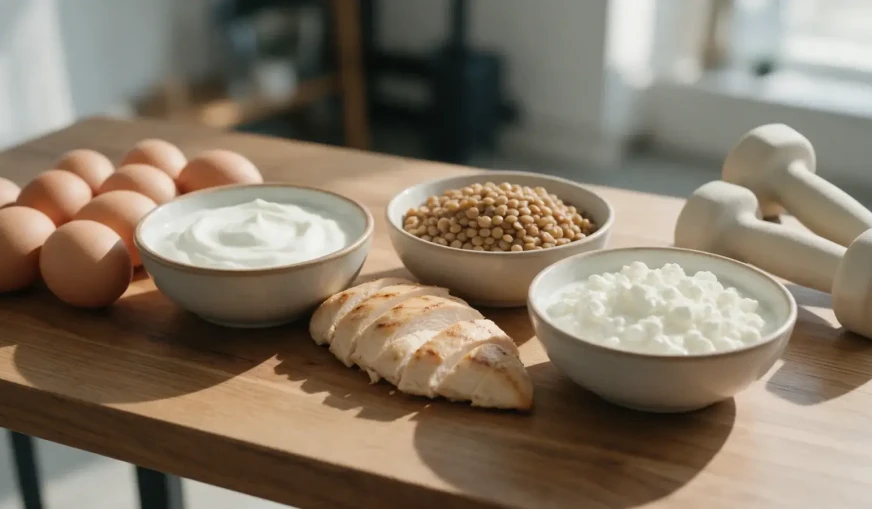
There are two basic ways of limiting muscle loss while using a weight-loss injection: getting enough protein every day, spread across meals, and doing strength exercise on at least two days a week. Although the general adult recommendation is 0.8 grams of protein per kilogram a day, higher targets such as 1.2–1.6 g/kg are suggested during active weight loss; the amount that suits you depends on your weight, your age and your kidney health.
Because medicines such as semaglutide and tirzepatide reduce appetite markedly, getting protein in this period can be harder than you think. A common pattern is protein intake that is down to a few slices of cheese and a little yoghurt at the end of the day despite a rapid fall on the scales. In this article I explain why muscle loss matters and how it can be prevented in practice.
- In rapid weight loss, part of the weight lost can come from lean tissue, that is muscle and other tissues.
- The general recommendation is 0.8 g/kg of protein a day; targets of 1.2–1.6 g/kg are suggested during active weight loss.
- Spreading protein across every main meal rather than taking it in one meal is more effective.
- Strength exercise is as important a leg of preserving muscle mass as diet.
- In people with kidney disease, the protein target must always be set with a doctor and dietitian.
Do Weight-Loss Injections Cause Muscle Loss?
When you lose weight there is always some loss of lean tissue alongside fat; this is not unique to medicines. But because weight loss with weight-loss injections can be fast and large, the amount of muscle lost can also be striking.
In a systematic review published in 2026 that examined 35 randomised studies, a median of about 28% of the total weight lost with incretin-based medicines was found to come from a reduction in muscle-related measurements; in about two-thirds of the studies this proportion was above the reference value set by the researchers. The authors note that the same thing was seen in about half of the non-medicine weight-loss methods too. In short, the issue is not only the medicine but rapid weight loss itself.
Muscle mass matters for daily function, balance, bone health and blood sugar balance. Muscle loss can also affect the tendency for weight to return when the medicine is stopped. So the goal is not only to bring down the number on the scales but to make sure that, as far as possible, the loss comes from fat.
How Is Daily Protein Need Calculated?
The recommended amount of protein for the general adult population is 0.8 grams per kilogram a day. The 2025 joint statement on nutritional priorities in GLP-1 therapy says that higher targets such as 1.2–1.6 g/kg are suggested during active weight loss, but that in people with obesity it may be more accurate to base the calculation on adjusted weight or lean mass rather than actual weight. According to the same statement, protein intake should not fall below 0.4–0.5 g/kg a day and should not be kept at 2 g/kg or above for long.
| Weight used for calculation | 0.8 g/kg (general recommendation) | 1.2 g/kg | 1.6 g/kg |
|---|---|---|---|
| 60 kg | 48 g | 72 g | 96 g |
| 70 kg | 56 g | 84 g | 112 g |
| 80 kg | 64 g | 96 g | 128 g |
The “weight used for calculation” in the table may, in the presence of obesity, be not your actual weight but an adjusted value that your dietitian will determine. If you have chronic kidney disease, liver disease or another health problem, be sure to set your protein target together with your doctor and dietitian. I explained in detail how protein needs change with age and activity in the article on how to calculate daily protein needs.
How Should Protein Be Spread Across Meals?
Instead of getting all your protein at dinner, spreading it across the three main meals and, if needed, snacks both makes it easier to reach the target in a period of low appetite and lets the muscles receive building blocks regularly through the day. In practice, aiming for about 20–30 grams of protein at each main meal is a framework that works for most people.
- Protein first: If your appetite is limited, eat the protein source on the plate first.
- Strengthen breakfast: Instead of a single slice of cheese, think of egg, cheese and yoghurt together.
- Choose protein-focused snacks: Strained yoghurt, ayran (Turkish salted yoghurt drink), kefir, lor (Turkish fresh curd cheese) or a handful of nuts.
- Make use of fluid options: On days with nausea, milk, kefir or ayran may be tolerated more easily than solid food.
How Much Protein Is in Which Foods?
The values below are approximate figures based on USDA FoodData Central data; they vary with the product and cooking method.
| Food | Portion | Approximate protein |
|---|---|---|
| Chicken breast (cooked) | 100 g | 30 g |
| Red meat / köfte (Turkish meatballs) (cooked) | 100 g | 25 g |
| Fish (cooked) | 100 g | 22–25 g |
| Lentils (cooked) | 1 cup (about 200 ml; ~200 g) | 18 g |
| Strained yoghurt | 150 g | 15 g |
| Chickpeas (cooked) | 1 cup (about 200 ml; ~165 g) | 14 g |
| Lor cheese | 100 g | 11 g |
| Kefir or milk | 1 cup (about 200 ml) | 6.5–7 g |
| Egg | 1 | 6 g |
| Almonds | 1 handful (30 g) | 6 g |
| White cheese | a matchbox-sized piece (30 g) | 5 g |
A sample day with about 90 grams of protein
- Breakfast: 2 eggs, 30 g of white cheese, tomato and cucumber, 1 slice of wholemeal bread (about 20 g)
- Snack: 150 g of strained yoghurt and a few slices of fruit (about 15 g)
- Lunch: 100 g of grilled chicken, vegetables cooked in olive oil, a few spoonfuls of bulgur (about 33 g)
- Snack: 1 cup (about 200 ml) of kefir (about 7 g)
- Dinner: Soup made with half a cup (about 100 ml) of lentils and 70 g of baked fish, salad (about 25 g)
If your appetite is not up to this, you can make portions smaller and increase the number of meals. Before turning to products such as protein powder, assess with your dietitian how close you can get to the target through food.
Why Is Strength Exercise Essential?
Protein provides the building blocks needed to protect muscle; but it is exercise that gives the muscle the signal that it is “worth keeping”. That is why simply increasing protein may not be enough to prevent muscle loss without exercise.
The US National Institute of Diabetes and Digestive and Kidney Diseases (NIDDK) recommends at least 150 minutes of moderate-intensity aerobic activity a week and muscle-strengthening exercise on at least two days. A 2025 review also stresses that, to limit muscle loss during GLP-1 therapy, eating rich in protein and fibre should be combined with supervised aerobic and resistance exercise.
- Start with body weight: wall push-ups, standing up from and sitting down on a chair, the bridge move.
- Work two or three days a week with resistance bands or light dumbbells.
- Increase the load and number of repetitions gradually over time.
- For a sample programme you can look at the article on exercise and nutrition while using weight-loss injections.
- If you have a heart, joint or other health problem, plan the programme with your doctor and an exercise specialist.
What Mistakes Increase Muscle Loss?
Some habits can, without you noticing, speed up muscle loss alongside the medicine. Knowing them is the first step in preventing it.
- Skipping meals because there is no appetite and getting through the day on a few snacks
- Leaving protein only for dinner
- Seeing a rapid fall on the scales as the only measure of success
- Doing no strength exercise at all apart from walking
- Too little fluid and sleep
To monitor muscle loss, not only the scales but also body composition measurements, waist measurement and changes in your daily function should be tracked. I covered this topic from the point of view of weight loss without medicines too, in the article on whether it is possible to lose weight without losing muscle. For a general meal routine while using the medicine, you can look at the nutrition guide for people using weight-loss injections, and for the process of stopping the medicine, the article on whether weight comes back when you stop weight-loss injections.
To track your protein target, exercise routine and body composition together, in a way that fits with your doctor's treatment plan, we can work together within sports nutrition and muscle-preservation counselling.
Sources
- Mozaffarian D et al. Nutritional priorities to support GLP-1 therapy for obesity. Obesity (Silver Spring), 2025 (PubMed)
- Batsis JA et al. Effect of Incretin-Based and Nonpharmacologic Weight Loss on Body Composition: A Systematic Review. Ann Intern Med, 2026 (PubMed)
- Barana L et al. Nutrition and Physical Activity in Optimizing Weight Loss and Lean Mass Preservation in the Incretin-Based Medications Era. Nutrients, 2025 (PubMed)
- NIDDK – Prescription Medications to Treat Overweight & Obesity
This article is for general information only; please consult your doctor and dietitian about your own situation.
Frequently Asked Questions
How many grams of protein should I have a day while using a weight-loss injection?
The general recommendation is 0.8 grams per kilogram a day; higher targets such as 1.2–1.6 g/kg are suggested during active weight loss. In the presence of obesity the calculation can be made on adjusted weight; in people with kidney disease the target should be set with a doctor.
Is it necessary to use protein powder?
Most people can meet their protein needs with eggs, dairy products, meat, chicken, fish and pulses. If appetite is very low or the target cannot be reached through food, your dietitian can assess a suitable product; do not go up to high doses on your own.
Does walking alone prevent muscle loss?
Walking is valuable for general health and weight management, but strength exercises are also needed to protect muscle. Planning muscle-strengthening exercise on at least two days a week is recommended.
How can I tell whether I am losing muscle?
Signs such as loss of strength, difficulty climbing stairs and clothes fitting your body differently can give a clue. For a clearer assessment, body composition measurements and strength tests can be used; follow these with your doctor and dietitian.
Is too much protein harmful?
Very high protein intake is not necessary for everyone, and keeping it at 2 g/kg or above for long periods is not recommended. High protein also calls for care in people with kidney disease; set your target according to your personal health.
Book an appointment for a personalised nutrition plan
The information in this article is general; what you need depends on your age, health and goals. Message us and we will build the plan that suits you together.

This content is for information only. For a personalised nutrition programme, please consult a dietitian.


