

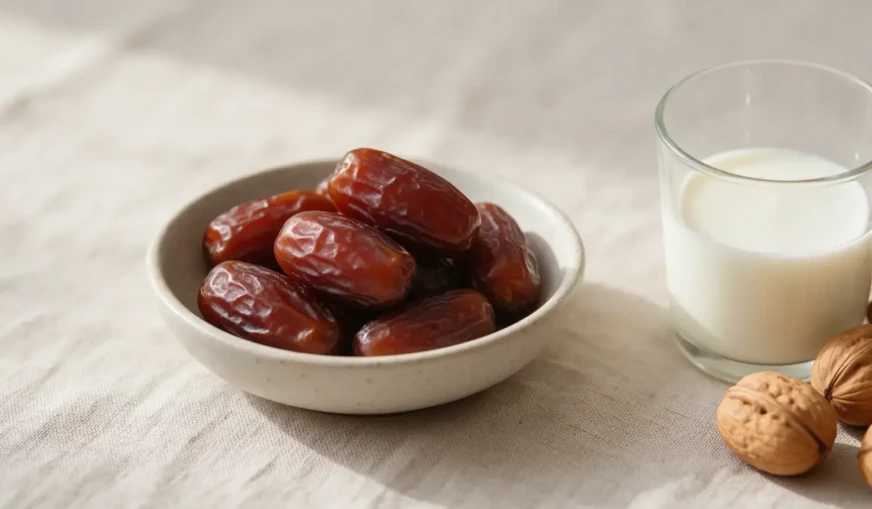
Yes, you can eat dates during pregnancy; they are a natural snack rich in fibre, potassium and energy. However, because they are high in sugar and calories, a sensible portion for most pregnant women is 2–3 small dates or 1–2 large Medjool dates a day; if you have been diagnosed with gestational diabetes, you should set the amount with your doctor and dietitian.
Dates often come up in the final weeks with the idea that they “make labour easier”. In this article I explain in plain language what dates contain, a safe portion, what research actually says and who needs to be more careful.
- Dates are a fibre-rich fruit, high in potassium, that can be eaten safely in pregnancy.
- They are high in sugar and energy, so keep the portion small.
- Studies on date consumption in the final weeks and the birth process are promising, but the evidence is limited.
- Dates may not be completely off limits with gestational diabetes, but the amount and timing should be planned individually.
- Eating dates together with protein and fat sources such as yoghurt, walnuts or almonds helps blood sugar rise more slowly.
What Is the Nutritional Value of Dates?
Dates are an energy-dense fruit made up largely of natural sugars, yet they also contain fibre, potassium, magnesium and some B vitamins. Because they are dried, even a small amount provides a considerable amount of energy.
The values below are approximate figures based on averages in food databases such as USDA and TürKomp (the Turkish food composition database); they vary with the type, size and moisture content of the date.
| Portion | Approximate weight | Approximate energy | Approximate carbohydrate | Approximate fibre |
|---|---|---|---|---|
| 1 large Medjool date | 24 g | 65–70 kcal | 18 g | 1.5 g |
| 1 small date (Deglet Nour etc.) | 7–8 g | 20–25 kcal | 5–6 g | 0.6 g |
| 100 g of dates | 100 g | around 280 kcal | 75 g | 7–8 g |
For comparison, a medium apple provides roughly 80–95 kcal. So one large date gives most of the energy of an apple in a much smaller volume. That is why eating dates by the handful because they are “healthy” can raise your energy intake without you noticing.
What Are the Benefits of Dates in Pregnancy?
The most noticeable contribution of dates in pregnancy is that, thanks to their fibre, they support bowel regularity and offer a more nourishing sweet option than desserts made with refined sugar. They also contribute minerals such as potassium and magnesium.
- Support for constipation: For constipation, which is common in pregnancy, dates can help alongside enough water and other high-fibre foods.
- An alternative to a sweet craving: Instead of a syrupy dessert or chocolate, 1–2 dates satisfy a sweet craving in a more balanced way.
- Practical energy: During periods when you can only eat a little because of nausea, or when travelling, they can be a small but nourishing snack.
The iron content of dates is often exaggerated; in fact they are not a good source of iron. For anaemia, lentils, chickpeas, well-cooked red meat and leafy green vegetables are far more valuable.
Does Eating Dates in the Final Weeks Make Labour Easier?
Some studies report that regular date consumption in the final weeks of pregnancy may have a positive effect on the ripening of the cervix and the birth process; however, most of these studies are small and use different methods. For this reason, dates should not be seen as a way of starting or speeding up labour.
A systematic review and meta-analysis published in 2024 stated that eating dates in the period around birth may be associated with some birth outcomes, but that higher-quality studies are needed. In short, dates can be eaten as part of a balanced diet; your birth plan, however, should be discussed with your obstetrician.
If you would like to eat dates in the final weeks, it is best to do so after talking to your doctor about your blood sugar, weight gain and overall eating pattern.
How Many Dates Can You Eat a Day in Pregnancy?
For most pregnant women who do not have gestational diabetes or rapid weight gain, 2–3 small or 1–2 large dates a day is a sensible amount, eaten in place of a portion of fruit. What matters is to think of dates as a replacement for other fruit, not an addition to it.
- Eat dates not on their own but with a bowl of yoghurt, a glass of milk or a few walnuts or almonds.
- Avoid eating a large amount on an empty stomach or late at night.
- Sugar is more concentrated in date syrup, date paste and date-based desserts; have these in moderation.
- Store dates in a clean, closed container; do not eat any that look mouldy, sticky or soured.
Can You Eat Dates With Gestational Diabetes?
If you have been diagnosed with gestational diabetes, dates do not have to be completely off limits, but because they can raise blood sugar quickly, the amount and timing should be planned individually. Many people can tolerate a single small date after a main meal, together with protein; for some it may not be suitable at all.
The most reliable way to find out is to look at your after-meal blood sugar measurements as your doctor has advised. For the details of eating with gestational diabetes, you can read my gestational diabetes nutrition guide.
What Should You Look Out for When Choosing and Storing Dates?
In pregnancy, choosing dates that are packaged, have a clear expiry date and look clean is safer than those sold loose and dusty. Dates glazed with sugar syrup, with glucose syrup added or stuffed have even more sugar and energy.
Keep an opened pack in a closed container in a cool, dry place or in the fridge. Do not eat any dates in which you notice mould, a sour smell or signs of insects. When removing the stones from unpitted dates, it is also a good habit to check the inside.
What Is the Best Way to Eat Dates in Pregnancy?
Combining dates with protein and healthy fat at a snack both keeps you full for longer and helps blood sugar run more evenly. Using them in place of a dessert is a practical way to reduce your total sugar intake.
- Yoghurt bowl: A bowl of yoghurt, a chopped date and a dessert spoon of walnuts.
- Porridge: Oats cooked in milk and sweetened with half a date instead of sugar.
- Snack plate: One date, a few almonds and a slice of cheese.
If you would like to make a date-based dessert at home, provided you keep the portion small, my chocolate dates recipe can give you an idea. I have gathered the foods to stay away from in pregnancy in the article on what not to eat during pregnancy.
If you would like a personal plan for sweet cravings, weight gain or blood sugar during your pregnancy, in line with your obstetrician's advice, you can look at my nutrition counselling for pregnancy page.
Sources
- BMC Pregnancy and Childbirth (2024) – Oral consumption of dates in the peripartum period: systematic review and dose-response meta-analysis
- NHS – Have a healthy diet in pregnancy
- WHO – Healthy diet
- Turkish Ministry of Health – Turkey Nutrition Guide (TÜBER) 2022
This article is for general information only; please consult your doctor and dietitian about your own situation.
Frequently Asked Questions
Can you eat dates in the first months of pregnancy?
Yes, a moderate amount of dates can be eaten at every stage of pregnancy. If you can only eat a little in the early months because of nausea, a small date and a few walnuts can be a practical snack; it is still important to keep the portion small.
Are dates good for constipation?
Because dates contain fibre they can help with constipation, but they are not enough on their own. Their effect is more noticeable when eaten with vegetables, wholegrains, pulses and enough water.
Are dates good for anaemia?
The iron content of dates is low, and they are not a reliable source for correcting anaemia. If you have iron deficiency in pregnancy, your doctor will plan the treatment; in your diet, well-cooked red meat, pulses and leafy green vegetables are more valuable.
Can you eat dates with milk?
Yes, eating dates with milk or yoghurt adds protein, keeps you fuller and helps blood sugar rise more slowly. In pregnancy, make sure the milk is pasteurised.
Do dates make you put on weight?
Because dates are an energy-dense fruit, eating a lot of them can contribute to gaining more weight than necessary in pregnancy. Limiting them to a few a day and using them in place of other sweets helps keep things in balance.
Book an appointment for a personalised pregnancy nutrition plan
Nutritional needs in pregnancy change with the week of pregnancy, weight change and test results. Message us for a plan that fits your doctor's advice.

This content is for information only. For a personalised nutrition programme, please consult a dietitian.


